
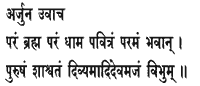
Arjuna said: Thou art the supreme Brahman, the supreme Abode, the supreme Purity, the one permanent, the divine Purusha, the original Godhead, the Unborn, the all-pervading Lord.
The Three Purushas
Sri Aurobindo
THE DOCTRINE of the Gita from the beginning to the end converges on all its lines and through all the flexibility of its turns towards one central thought, and to that it is arriving in all its balancing and reconciliation of the disagreements of various philosophic systems and its careful synthetising of the truths of spiritual experience, lights often conflicting or at least divergent when taken separately and exclusively pursued along their outer arc and curve of radiation, but here brought together into one focus of grouping vision. This central thought is the idea of a triple consciousness, three and yet one, present in the whole scale of existence. There is a spirit here at work in the world that is one in innumerable appearances. It is the developer of birth and action, the moving power of life, the inhabiting and associating consciousness in the myriad mutabilities of Nature; it is the constituting reality of all this stir in Time and Space; it is itself Time and Space and Circumstance. It is this multitude of souls in the worlds; it is the gods and men and creatures and things and forces and qualities and quantities and powers and presences. It is Nature, which is power of the Spirit, and objects, which are its phenomena of name and idea and form, and existences, who are portions and births and becomings of this single selfexistent spiritual entity, the One, the Eternal. But what we see obviously at work before us is not this Eternal and his conscious Shakti, but aNature which in the blind stress of her operations is ignorant of the spirit within her action. Her work is a confused, ignorant and limiting play of certain fundamental modes, qualities, principles of force in mechanical operation and the fixity or the flux of their consequences. And whatever soul comes to the
surface in her action, is itself in appearance ignorant, suffering, bound to the incomplete and unsatisfying play of this inferior Nature. The inherent Power in her is yet other than what it thus seems to be; for, hidden in its truth, manifest in its appearances, it is the Kshara, the universal Soul, the spirit in the mutability of cosmic phenomenon and becoming, one with the Immutable and the Supreme.We have to arrive at the hidden truth behind its manifest appearances; we have to discover the Spirit behind these veils and to see all as the One, v¯asudevah. sarvam iti, individual, universal, transcendent. But this is a thing impossible to achieve with any completeness of inner reality, so long as we live concentrated in the inferior Nature. For in this lesser movement Nature is an ignorance, a Maya; she shelters the Divine within its folds and conceals him from herself and her creatures. The Godhead is hidden by the Maya of his own all-creating Yoga, the Eternal figured in transience, Being absorbed and covered up by its own manifesting phenomena. In the Kshara taken alone as a thing in itself, the mutable universal apart from the undivided Immutable and the Transcendent, there is no completeness of knowledge, no completeness of our being and therefore no liberation. But then there is another spirit of whom we become aware and who is none of these things, but self and self only. This Spirit is eternal, always the same, never changed or affected by manifestation, the one, the stable, a self-existence undivided and not even seemingly divided by the division of things and powers in Nature, inactive in her action, immobile in her motion. It is the Self of all and yet unmoved, indifferent, intangible, as if all these things which depend upon it were not-self, not its own results and powers and consequences, but a drama of action developed before the eye of an unmoved unparticipating spectator. For the mind that stages and shares in the drama is other than the Self which indifferently contains the action. This spirit is timeless, though we see it in Time; it is unextended in space, though we see it as if pervading space.We become aware of it in proportion as we draw back from out inward, or look behind the action and motion for something that is eternal and stable, or get away from time and its creation to the uncreated, away from phenomenon to being, from the personal to impersonality, from becoming to unalterable self-existence. This is the Akshara, the immutable in the mutable, the immobile in the mobile, the imperishable in things perishable. Or rather, since there is only an appearance of pervasion, it is the immutable, immobile and imperishable in which proceeds all the mobility of mutable and perishable things. The Kshara spirit visible to us as all natural existence and the totality of all existences moves and acts pervadingly in the immobile and eternal Akshara. This mobile Power of Self acts in that fundamental stability of Self, as the second principle of material Nature, Vayu, with its contactual force of aggregation and separation, attraction and repulsion, supporting the formative force of the fiery (radiant, gaseous and electric) and other elemental movements, ranges pervadingly in the subtly massive stability of ether. This Akshara is the self higher than the buddhi —it exceeds even that highest subjective principle of Nature in our being, the liberating intelligence, through which man returning beyond his restless mobile mental to his calm eternal spiritual self is at last free from the persistence of birth and the long chain of action, of Karma. This self in its highest status, param˙ dha¯ma, is an unmanifest beyond even the unmanifest principle of the original cosmic Prakriti, Avyakta, and, if the soul turns to this Immutable, the hold of cosmos andNature falls away from it and it passes beyond birth to an unchanging eternal existence. These two then are the two spirits we see in the world; one emerges in front in its action, the other remains behind it steadfast in that perpetual silence from which the action comes and in which all actions cease and disappear into timeless being, Nirvana. Dv¯av imau purus.au loke ks.ara´s c¯aks.ara eva ca. The difficulty which baffles our intelligence is that these two seem to be irreconcilable opposites with no real nexus between them or any transition from the one to the other except by an intolerant movement of separation. The Kshara acts, or at least motives action, separately in the Akshara; the Akshara stands apart, self-centred, separate in its inactivity from the Kshara. At first sight it would almost seem better, more logical, more easy of comprehension, if we admitted with the Sankhyas an original and eternal duality of Purusha and Prakriti, if not even an eternal plurality of souls. Our experience of the Akshara would then be simply the withdrawal of each Purusha into himself, his turning away from Nature and therefore from all contact with other souls in the relations of existence; for each is self-sufficient and infinite and complete in his own essence. But after all the final experience is that of a unity of all beings which is not merely a community of experience, a common subjection to one force of Nature, but a oneness in the spirit, a vast identity of conscious being beyond all this endless variety of determination, behind all this apparent separativism of relative existence. The Gita takes its stand in that highest spiritual experience. It appears indeed to admit an eternal plurality of souls subject to and sustained by their eternal unity, for cosmos is for ever and manifestation goes on in unending cycles; nor does it affirm anywhere or use any expression that would indicate an absolute disappearance, laya, the annullation of the individual soul in the Infinite. But at the same time it affirms with a strong insistence that the Akshara is the one self of all these many souls, and it is therefore evident that these two spirits are a dual status of one eternal and universal existence. That is a very ancient doctrine; it is the whole basis of the largest vision of the Upanishads,—as when the Isha tells us that Brahman is both the mobile and the immobile, is the One and the Many, is the Self and all existences, a¯tman, sarvabhu¯ ta¯ni, is the Knowledge and the Ignorance, is the eternal unborn status and also the birth of existences, and that to dwell only on one of these things to the rejection of its eternal counterpart is a darkness of exclusive knowledge or a darkness of ignorance. It too insists like the Gita that man must know and must embrace both and learn of the Supreme in his entirety—samagram˙ ma¯m, as the Gita puts it—in order to enjoy immortality and live in the Eternal. The teaching of the Gita and this side of the teaching of the Upanishads are so far at one; for they look at and admit both sides of the reality and still arrive at identity as the conclusion and the highest truth of existence. But this greater knowledge and experience, however true and however powerful in its appeal to our highest seeing, has still to get rid of a very real and pressing difficulty, a practical as well as a logical contradiction which seems at first sight to persist up to the highest heights of spiritual experience. The Eternal is other than this mobile subjective and objective experience, there is a greater consciousness, na idam˙ yad upa¯sate:2 and yet at the same time all this is the Eternal, all this is the perennial self-seeing of the Self, sarvam˙ khalu idam˙ brahma,3 ayam a¯tma¯ brahma.4 The Eternal has become all existences, ¯atm¯a abh¯ ut sarv¯an.i bh¯ ut¯ ani;5 as the Swetaswatara puts it, “Thou art this boy and yonder girl and that old man walking supported on his staff,”—even as in the Gita the Divine says that he is Krishna and Arjuna and Vyasa and Ushanas, and the lion and the aswattha tree, and consciousness and intelligence and all qualities and the self of all creatures. But how are these two the same, when they seem not only so opposite in nature, but so difficult to unify in experience? For when we live in the mobility of the becoming, we may be aware of but hardly live in the immortality of timeless selfexistence. And when we fix ourselves in timeless being, Time and Space and circumstance fall away from us and begin to appear as a troubled dream in the Infinite. The most persuasive conclusion would be, at first sight, that the mobility of the spirit in Nature is an illusion, a thing real only when we live in it, but not real in essence, and that is why, when we go back into self, it falls away from our incorruptible essence. That is the familiar cutting of the knot of the riddle, brahma satyam˙ jagan mithya¯ . The Gita does not take refuge in this explanation which has enormous difficulties of its own, besides its failure to account for the illusion,—for it only says that it is all a mysterious and incomprehensibleMaya, and then we might just as well say that it is all a mysterious and incomprehensible double reality, spirit concealing itself from spirit. The Gita speaks of Maya, but only as a bewildering partial consciousness which loses hold of the
complete reality, lives in the phenomenon of mobile Nature and has no sight of the Spirit of which she is the active Power, me prakr.tih. . When we transcend this Maya, the world does not disappear, it only changes its whole heart of meaning. In the spiritual vision we find not that all this does not really exist, but rather that all is, but with a sense quite other than its present mistaken significance: all is self and soul and nature of the Godhead, all is Vasudeva. The world for the Gita is real, a creation of the Lord, a power of the Eternal, a manifestation from the Parabrahman, and even this lower nature of the triple Maya is a derivation from the supreme divine Nature. Nor can we take refuge altogether in this distinction that there is a double, an inferior active and temporal and a superior calm, still and eternal reality beyond action and that our liberation is to pass from this partiality to that greatness, from the action to the silence. For the Gita insists that we can and should, while we live, be conscious in the self and its silence and yet act with power in the world of Nature. And it gives the example of the Divine himself who is not bound by necessity of birth, but free, superior to the cosmos, and yet abides eternally in action, varta eva ca karman. i. Therefore it is by putting on a likeness of the divine nature in its completeness that the unity of this double experience becomes entirely possible. But what is the principle of that oneness? The Gita finds it in its supreme vision of the Purushottama; for that is the type, according to its doctrine, of the complete and the highest experience, it is the knowledge of the whole-knowers, kr.tsnavidah. . The Akshara is para, supreme in relation to the elements and action of cosmicNature. It is the immutable Self of all, and the immutable Self of all is the Purushottama. The Akshara is he in the freedom of his self-existence unaffected by the action of his own power in Nature, not impinged on by the urge of his own becoming, undisturbed by the play of his own qualities. But this is only one aspect though a great aspect of the integral knowledge. The Purushottama is at the same time greater than the Akshara, because he is more than this immutability and he is not limited even by the highest eternal status of his being, param˙ dh¯ama. Still, it is through whatever is immutable and eternal in us that we arrive at that highest status from which there is no returning to birth, and that was the liberation which was sought by the wise of old, the ancient sages. But when pursued through the Akshara alone, this attempt at liberation becomes the seeking of the Indefinable, a thing hard for our nature embodied as we are here in Matter. The Indefinable, to which the Akshara, the pure intangible self here in us rises in its separative urge, is some supreme Unmanifest, paro avyaktah. , and that highest unmanifest Akshara is still the Purushottama. Therefore, the Gita has said, those also who follow after the Indefinable, come to me, the eternal Godhead. But yet is he more even than a highest unmanifest Akshara, more than any negative Absolute, neti neti, because he is to be known also as the supreme Purusha who extends this whole universe in his own existence. He is a supreme mysterious All, an ineffable positive Absolute of all things here. He is the Lord in the Kshara, Purushottama not only there, but here in the heart of every creature, Ishwara. And there too even in his highest eternal status, paro avyaktah., he is the supreme Lord, Parameshwara, no aloof and unrelated Indefinable, but the origin and father and mother and first foundation and eternal abode of self and cosmos andMaster of all existences and enjoyer of askesis and sacrifice. It is by knowing him at once in the Akshara and the Kshara, it is by knowing him as the Unborn who partially manifests himself in all birth and even himself descends as the constant Avatar, it is by knowing him in his entirety, samagram˙ ma¯m, that the soul is easily released from the appearances of the lower Nature and returns by a vast sudden growth and broad immeasurable ascension into the divine being and supremeNature. For the truth of the Kshara too is a truth of the Purushottama. The Purushottama is in the heart of every creature and is manifested in his countless Vibhutis; the Purushottama is the cosmic spirit in Time and it is he that gives the command to the divine action of the liberated human spirit. He is both Akshara and Kshara, and yet he is other because he is more and greater than either of these opposites. Uttamah. purus.as tvanyah. param¯atmetyud¯ahr.tah. , yo lokatrayam ¯ avi´sya bibhartyavyaya ¯ı´svarah. , “But other than these two is that highest spirit called the supreme Self, who enters the three worlds and upbears them, the imperishable Lord.” This verse is the keyword of the Gita’s reconciliation of these two apparently opposite aspects of our existence. The idea of the Purushottama has been prepared, alluded to, adumbrated, assumed even from the beginning, but it is only now in the fifteenth chapter that it is expressly stated and the distinction illuminated by a name. And it is instructive to see how it is immediately approached and developed. To ascend into the divine nature, we have been told, one must first fix oneself in a perfect spiritual equality and rise above the lower nature of the three gunas. Thus transcending the lower Prakriti we fix ourselves in the impersonality, the imperturbable superiority to all action, the purity from all definition and limitation by quality which is one side of the manifested nature of the Purushottama, his manifestation as the eternity and unity of the self, the Akshara. But there is also an ineffable eternal multiplicity of the Purushottama, a highest truest truth behind the primal mystery of soul manifestation. The Infinite has an eternal power, an unbeginning and unending action of his divine Nature, and in that action the miracle of soul personality emerges from a play of apparently impersonal forces, prakr.tir jı¯vabhu¯ ta¯. This is possible because personality too is a character of the Divine and finds in the Infinite its highest spiritual truth and meaning. But the Person in the Infinite is not the egoistic, separative, oblivious personality of the lower Prakriti; it is something exalted, universal and transcendent, immortal and divine. That mystery of the supreme Person is the secret of love and devotion. The spiritual person, purus.a, the eternal soul in us offers itself and all it has and is to the eternal Divine, the supreme Person and Godhead of whom it is a portion, am˙ s´a. The completeness of knowledge finds itself in this self-offering, this uplifting of our personal nature by love and adoration to the ineffable Master of our personality and its acts; the sacrifice of works receives by it its consummation and perfect sanction. It is then through these things that the soul of man fulfils itself most completely in this other and dynamic secret, this other great and intimate aspect of the divine nature and possesses by that fulfilment the foundation of immortality, the supreme felicity and the eternal Dharma. And having so stated this double requisite, equality in the one self, adoration of the one Lord, at first separately as if they were two different ways of arriving at the Brahmic status, brahmabhu¯ ya¯ya,—one taking the form of quietistic sannya¯sa, the other a form of divine love and divine action,—the Gita proceeds now to unite the personal and the impersonal in the Purushottama and to define their relations. For the object of the Gita is to get rid of exclusions and separative exaggerations and fuse these two sides of knowledge and spiritual experience into a single and perfect way to the supreme perfection. First there comes a description of cosmic existence in the Vedantic image of the aswattha tree. This tree of cosmic existence has no beginning and no end, n¯anto na c¯adih. , in space or in time; for it is eternal and imperishable, avyaya. The real form of it cannot be perceived by us in this material world of man’s embodiment, nor has it any apparent lasting foundation here; it is an infinite movement and its foundation is above in the supreme of the Infinite. Its principle is the ancient sempiternal urge to action, pravr.tti, which for ever proceeds without beginning or end from the original Soul of all existence, a¯dyam˙ purus.am˙ yatah. pravr.ttih. prasr.t ¯a pur¯an. ¯ı. Therefore its original source is above, beyond Time in the Eternal, but its branches stretch down below and it extends and plunges its other roots, well-fixed and clinging roots of attachment and desire with their consequences of more and more desire and an endlessly developing action, plunges them downward here into the world of men. The hymns of the Veda are compared to its leaves and the man who knows this tree of the cosmos is the Veda-knower. And here we see the sense of that rather disparaging view of the Veda or at least of the Vedavada, which we had to notice at the beginning. For the knowledge the Veda gives us is a knowledge of the gods, of the principles and powers of the cosmos, and its fruits are the fruits of a sacrifice which is offered with desire, fruits of enjoyment and lordship in the nature of the three worlds, in earth and heaven and the world between earth and heaven. The branches of this cosmic tree extend both below and above, below in the material, above in the supraphysical planes; they grow by the gunas of Nature, for the triple guna is all the subject of the Vedas, traigun. ya-vis.aya¯ veda¯h. . The Vedic rhythms, chanda¯m˙ si, are the leaves and the sensible objects of desire supremely gained by a right doing of sacrifice are the constant budding of the foliage. Man, therefore, so long as he enjoys the play of the gunas and is attached to desire, is held in the coils of Pravritti, in the movement of birth and action, turns about constantly between the earth and the middle planes and the heavens and is unable to get back to his supreme spiritual infinitudes. This was perceived by the sages. To achieve liberation they followed the path of Nivritti or cessation from the original urge to action, and the consummation of this way is the cessation of birth itself and a transcendent status in the highest supracosmic reach of the Eternal. But for this purpose it is necessary to cut these longfixed roots of desire by the strong sword of detachment and then to seek for that highest goal whence, once having reached it, there is no compulsion of return to mortal life. To be free from the bewilderment of this lowerMaya, without egoism, the great fault of attachment conquered, all desires stilled, the duality of joy and grief cast away, always to be fixed in wide equality, always to be firm in a pure spiritual consciousness, these are the steps of the way to that supreme Infinite. There we find the timeless being which is not illumined by sun or moon or fire, but is itself the light of the presence of the eternal Purusha. I turn away, says the Vedantic verse, to seek that original Soul alone and to reach him in the great passage. That is the highest status of the Purushottama, his supracosmic existence. But it would seem that this can be attained very well, best even, pre-eminently, directly, by the quiescence of Sannyasa. Its appointed path would seem to be the way of the Akshara, a complete renunciation of works and life, an ascetic seclusion, an ascetic inaction. Where is the room here, or at least where is the call, the necessity, for the command to action, and what has all this to do with the maintenance of the cosmic existence, lokasan˙ graha, the slaughter of Kurukshetra, the ways of the Spirit in Time, the vision of the million-bodied Lord and his highvoiced bidding, “Arise, slay the foe, enjoy a wealthy kingdom”? And what then is this soul in Nature? This spirit too, this Kshara, this enjoyer of our mutable existence, is the Purushottama; it is he in his eternal multiplicity, that is the Gita’s answer. “It is an eternal portion of me that becomes the Jiva in a world of Jivas.” This is an epithet, a statement of immense bearing and consequence. For it means that each soul, each being in its spiritual reality is the very Divine, however partial its actual manifestation of him in Nature. And it means too, if words have any sense, that each manifesting spirit, each of the many, is an eternal individual, an eternal unborn and undying power of the one Existence. We call this manifesting spirit the Jiva, because it appears here as if a living creature in a world of living creatures, and we speak of this spirit in man as the human soul and think of it in the terms of humanity only. But in truth it is something greater than its present appearance and not bound to its humanity: it was a lesser manifestation than the human in its past, it can become something much greater than mental man in its future. And when this soul rises above all ignorant limitation, then it puts on its divine nature of which its humanity is only a temporary veil, a thing of partial and incomplete significance. The individual spirit exists and ever existed beyond in the Eternal, for it is itself everlasting, san¯atana. It is evidently this idea of the eternal individual which leads the Gita to avoid any expression at all suggestive of a complete dissolution, laya, and to speak rather of the highest state of the soul as a dwelling in the Purushottama, nivasis.yasi mayyeva. If when speaking of the one Self of all it seems to use the language of Adwaita, yet this enduring truth of the eternal individual, mama¯m˙ s´ah. san¯atanah. , adds something which brings in a qualification and appears almost to accept the seeing of the Visishtadwaita,— though we must not therefore leap at once to the conclusion that that alone is the Gita’s philosophy or that its doctrine is identical with the later doctrine of Ramanuja. Still this much is clear that there is an eternal, a real and not only an illusive principle of multiplicity in the spiritual being of the one divine Existence. This eternal individual is not other than or in any way really separate from the Divine Purusha. It is the Lord himself, the Ishwara who by virtue of the eternal multiplicity of his oneness —is not all existence a rendering of that truth of the Infinite?— exists for ever as the immortal soul within us and has taken up this body and goes forth from the transient framework when it is cast away to disappear into the elements of Nature. He brings in with him and cultivates for the enjoyment of the objects of mind and sense the subjective powers of Prakriti, mind and the five senses, and in his going forth too he goes taking them as the wind takes the perfumes from a vase. But the identity of the Lord and the soul in mutable Nature is hidden from us by outward appearance and lost in the crowding mobile deceptions of that Nature. And those who allow themselves to be governed by the figures of Nature, the figure of humanity or any other form, will never see it, but will ignore and despise the Divine lodged in the human body. Their ignorance cannot perceive him in his coming in and his going forth or in his staying and enjoying and assumption of quality, but sees only what is there visible to the mind and senses, not the greater truth which can only be glimpsed by the eye of knowledge. Never can they have sight of him, even if they strive to do so, until they learn to put away the limitations of the outward consciousness and build in themselves their spiritual being, create for it, as it were, a form in their nature. Man, to know himself, must be kr.t ¯atm¯a, formed and complete in the spiritual mould, enlightened in the spiritual vision. The Yogins who have this eye of knowledge, see the Divine Being we are in their own endless reality, their own eternity of spirit. Illumined, they see the Lord in themselves and are delivered from the crude material limitation, from the form of mental personality, from the transient life formulation: they dwell immortal in the truth of the self and spirit. But they see him too not only in themselves, but in all the cosmos. In the light of the sun that illumines all this world they witness the light of the Godhead which is in us; the light in the moon and in fire is the light of the Divine. It is the Divine who has entered into this form of earth and is the spirit of its material force and sustains by his might these multitudes. The Divine is the godhead of Soma who by the rasa, the sap in the Earth-mother, nourishes the plants and trees that clothe her surface. The Divine and no other is the flame of life that sustains the physical body of living creatures and turns its food into sustenance of their vital force. He is lodged in the heart of every breathing thing; from him are memory and knowledge and the debates of the reason. He is that which is known by all the Vedas and by all forms of knowing; he is the knower of Veda and the maker of Vedanta. In other words, the Divine is at once the Soul of matter and the Soul of life and the Soul of mind as well as the Soul of the supramental light that is beyond mind and its limited reasoning intelligence. Thus the Divine is manifest in a double soul of his mystery, a twofold power, dv¯av imau purus.au; he supports at once the spirit of mutable things that is all these existences, ks.arah. sarv ¯an.i bh¯ut¯ ani, and the immutable spirit that stands above them in his imperturbable immobility of eternal silence and calm. And it is by the force of the Divine in them that the mind and heart and will of man are so powerfully drawn in different directions by these two spirits as if by opposing and incompatible attractions one insistent to annul the other. But the Divine is neither wholly the Kshara, nor wholly the Akshara. He is greater than the immutable Self and he is much greater than the Soul of mutable things. If he is capable of being both at once, it is because he is other than they, anyah. , the Purushottama above all cosmos and yet extended in the world and extended in the Veda, in self-knowledge and in cosmic experience. And whoever thus knows and sees him as the Purushottama, is no longer bewildered whether by the world-appearance or by the separate attraction of these two apparent contraries. These at first confront each other here in him as a positive of the cosmic action and as its negative in the Self who has no part in an action that belongs or seems to belong entirely to the ignorance of Nature. Or again they challenge his consciousness as a positive of pure, indeterminable, stable, eternal self-existence and as its negative of a world of elusive determinations and relations, ideas and forms, perpetual unstable becoming and the creating and uncreating tangle of action and evolution, birth and death, appearance and disappearance. He embraces and escapes them, overcomes their opposition and becomes allknowing, sarvavid, a whole-knower. He sees the entire sense both of the self and of things; he restores the integral reality of the Divine;6 he unites the Kshara and the Akshara in the Purushottama. He loves, worships, cleaves to and adores the supreme Self of his and all existence, the one Lord of his and all energies, the close and far-off Eternal in and beyond the world. And he does this too with no single side or portion of himself, exclusive spiritualised mind, blinding light of the heart intense but divorced from largeness, or sole aspiration of the will in works, but in all the perfectly illumined ways of his being and his becoming, his soul and his nature. Divine in the equality of his imperturbable self-existence, one in it with all objects and creatures, he brings that boundless equality, that deep oneness down into his mind and heart and life and body and founds on it in an indivisible integrality the trinity of divine love, divine works and divine knowledge. This is the Gita’s way of salvation. And is that not too after all the real Adwaita which makes no least scission in the one eternal Existence? This utmost undividing Monism sees the one as the one even in the multiplicities of Nature, in all aspects, as much in the reality of self and of cosmos as in that greatest reality of the supracosmic which is the source of self and the truth of the cosmos and is not bound either by any affirmation of universal becoming or by any universal or absolute negation. That at least is the Adwaita of the Gita. This is the most secret Shastra, says the Teacher to Arjuna; this is the supreme teaching and science which leads us into the heart of the highest mystery of existence. Absolutely to know it, to seize it in knowledge and feeling and force and experience is to
be perfected in the transformed understanding, divinely satisfied in heart and successful in the supreme sense and objective of all will and action and works. It is the way to be immortal, to rise towards the highest divine nature and to assume the eternal Dharma.
Sri Aurobindo
 About Us| ©1999 - 2009 searchforlight.org
All extracts and quotations from the written works of Sri Aurobindo and the Mother and the Photographs of
the Mother and Sri Aurobindo are copyright Sri Aurobindo Ashram Trust, Pondicherry -605002 India.